The Right to Work rules changed on 1 October 2026.For construction, the biggest change isn't simply who needs to be checked. It's how much you need to know about the supply chain behind the people delivering your projects.
Construction rarely operates through a simple employer-to-worker relationship.
A principal contractor appoints a subcontractor. That business appoints another subcontractor or labour provider. Individual workers may then arrive on site several contractual relationships away from the company at the top.
Until now, much of the responsibility for Right to Work checks has sat comfortably with the worker's direct employer.
The new rules make that position more complicated.
Right to Work requirements now extend into a wider range of working arrangements and, in specified circumstances, liability can extend further up the contractual chain.
For principal contractors, that creates a very practical question:
If you picked a worker on one of your projects today, could you immediately identify who employs or directly engages them – and evidence the controls operating around that relationship?
That's why the bigger issue isn't simply Right to Work.
It's assurance beyond Tier 1.
What changed to Right to Work on 1 October 2026?
From 1 October 2026, the scope of the Right to Work regime has widened beyond traditional employment relationships.
It can now apply to additional working arrangements, including worker contracts and certain individual subcontracting arrangements.
The changes also introduce extended liability in specified contractual structures. This means businesses further up a contractual chain can potentially face civil penalty exposure where illegal working occurs.
That's particularly significant for construction.
A principal contractor might appoint a Tier 1 subcontractor to deliver a package of work. That business might subcontract part of the package to another company, which might then source workers through another organisation or individual subcontractors.
The person ultimately carrying out the work may therefore be several tiers removed from the principal contractor.
And labels alone don't determine whether an arrangement falls inside or outside the rules. Calling someone “self-employed”, for example, does not by itself determine their status under the Right to Work regime.
Businesses need to understand how their workforce and contractual arrangements actually operate.
Does the principal contractor now have to carry out every Right to Work check?
No – and this distinction matters.
The organisation with the direct relationship remains responsible for carrying out the prescribed Right to Work check where required.
The changes do not simply transfer responsibility for every check to the principal contractor.
However, where a business further up the contractual chain is potentially exposed under the extended liability provisions, it needs to consider whether it can establish its own statutory excuse against a civil penalty.
That requires more than adding a generic compliance clause to a subcontract.
The Home Office guidance sets out prescribed contractual requirements for relevant arrangements, alongside the need for practical controls and evidence that those arrangements operate effectively.
For construction businesses, the message is important:
A contractual promise that somebody else will complete the appropriate checks is not, on its own, the same as being able to demonstrate effective Right to Work assurance.
Why is this particularly challenging for construction?
Because the supply chain you appoint isn't necessarily the supply chain that ultimately delivers the project.
Principal contractors generally have good visibility of their directly appointed subcontractors.
Beyond Tier 1, things can become less clear.
New subcontractors can enter the project. Labour providers can be introduced. Workers can move between employers and projects. Substitution can occur. Delivery arrangements can change as packages progress.
Meanwhile, the information needed to understand those relationships can be spread across procurement systems, contractor databases, spreadsheets, emails, workforce platforms and the systems used on site.
So when somebody asks:
“Who employs this worker?”
the answer isn't necessarily immediately available.
That matters because identifying the employer or direct engager is fundamental to understanding who is responsible for the worker and where they sit within the contractual chain.
And if establishing that relationship requires a series of phone calls to subcontractors every time an issue arises, the business doesn't really have supply-chain visibility.
Right to Work enforcement is increasing
These changes are also arriving against a backdrop of significantly increased illegal-working enforcement.
Home Office figures show that Immigration Enforcement conducted 7,270 illegal-working visits between January and June 2026, up 31% compared with the same period in 2025.
Those visits resulted in 4,756 arrests.
Construction saw an even sharper increase.
Visits to construction locations rose from 107 in the first half of 2025 to 268 in the first half of 2026 – an increase of 150%.
Across all sectors, more than 1,200 businesses were issued with civil penalties in the first six months of 2026, worth more than £74 million.
The potential civil penalties are significant too: the starting point is £45,000 per illegal worker for a first breach and £60,000 per illegal worker for a repeat breach, subject to the applicable penalty framework.
For principal contractors, however, the potential impact isn't limited to the fine.
An enforcement issue can mean workers being removed from site, project disruption, management time, investigations, legal costs and client scrutiny.
The practical objective should therefore be to identify problems and gaps before an enforcement visit puts your processes to the test.
Six practical steps principal contractors should take now
The Right to Work changes shouldn't result in another isolated compliance process.
They should prompt principal contractors to look at how subcontractors, employers, workers, checks and site controls connect.
Map the real supply chain
Start with a basic question: who is actually delivering the work?
That means going beyond the Tier 1 subcontractors originally appointed and understanding the lower-tier organisations, labour providers and employers subsequently introduced.
For each organisation, you should be able to understand who engaged them and where they sit within the project delivery chain.
Know who employs or engages each worker
Connecting a worker to the correct employer or direct engager is fundamental.
Without that relationship, it becomes much harder to establish who was responsible for the relevant checks, who should be contacted when something is wrong and where the worker sits within the wider subcontracting arrangement.
This information needs to be reliable enough to use when it matters – not reconstructed after an incident.
Review relevant contractual arrangements
Contracts entered into from 1 October should be reviewed against the new requirements where the extended liability provisions are relevant.
The final Home Office guidance addresses requirements around matters including Right to Work checks, further subcontracting, audit rights, enforcement and co-operation with investigations.
Businesses should take appropriate legal advice on how those requirements apply to their particular contracting models.
But remember: the contract is the starting point, not the entire control.
Control substitution
Substitution deserves particular attention in construction.
Where another person can replace the originally proposed worker, the business needs to know who actually arrived to perform the work.
A robust process should ensure the substitute follows the appropriate approval and checking process before starting work rather than becoming visible only after they are already on site.
Connect assurance to identity and site access
There is an important difference between having a valid worker record and knowing who is physically carrying out the work.
Principal contractors should consider how worker profiles, photographs, pre-registration, site induction, access controls and attendance records work together.
The objective is simple:
Can you connect the person whose status was assured with the person who actually turned up and worked on the project?
Retain evidence of what actually happened
Policies describe what should happen.
Evidence demonstrates what did happen.
Businesses should consider how they retain evidence of contractor and employer relationships, worker assurance, changes to the supply chain, exceptions identified and actions taken.
That becomes particularly valuable when responding to an audit, investigation or client enquiry months after the original decision was made.
What does good Right to Work assurance look like?
For a principal contractor, the process can be thought about as four connected questions:
Employer identification
Who employs or directly engages this worker, and where does that organisation sit in the supply chain?
Employer assurance
Has the responsible organisation completed the appropriate process and provided the required assurance?
Substitution control
Is the person arriving on site the individual associated with that approved worker record?
Identity-assured attendance
Is that same approved individual actually attending and working on the project?
The value comes from connecting those questions.
A Right to Work process sitting separately from contractor management, site induction and attendance can leave important gaps between what the business believes should be happening and what is actually happening on site.
How MSite helps principal contractors see beyond Tier 1
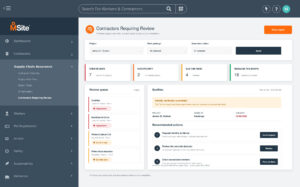
This is the challenge MSite Supply Chain Assurance is designed to address.
Rather than looking at workforce assurance and supply-chain assurance separately, MSite connects the contractor hierarchy, worker-employer relationships and live project activity.
That helps principal contractors see how work and labour are actually being delivered through their projects.
At project level, teams can understand:
- who is contracted to whom;
- which lower-tier organisations are delivering work or supplying labour;
- who employs or directly engages each worker;
- where that employer sits within the wider supply chain;
- where unverified or unexpected relationships require attention; and
- what exceptions, reviews and actions have taken place.
This creates a clearer connection between the supply chain you expected to deliver the project and the businesses and people actually delivering it.
MSite then connects that supply-chain picture with the workforce controls already operating around the worker.
Pre-Registration and Site Induction can support confirmation that the person presenting for work corresponds with the approved worker profile.
Site Access and Attendance can connect that profile with the individual actually attending the project.
The aim isn't to claim that technology removes Right to Work risk or guarantees compliance.
It's to give principal contractors better visibility, stronger controls and clearer evidence of the assurance process operating across the project.
Five questions to ask about your projects today
There is a straightforward way to test how prepared your organisation is.
Choose a worker currently delivering one of your projects and ask:
- Who employs or directly engages them?
- Where does that organisation sit within our subcontracting chain?
- Who was responsible for the relevant Right to Work process?
- What evidence do we have that our required controls operated in practice?
- Can we demonstrate that the person whose status was assured is the person actually attending site?
If those answers are immediately available, you have a strong starting point.
If answering them requires several phone calls, spreadsheets, emails and conversations with the Tier 1 contractor, there is a visibility gap worth addressing.
Because the question principal contractors increasingly need to answer isn't simply:
“Do our subcontractors carry out Right to Work checks?”
It's:
“How do we know?”
Know the supply chain. Know the workforce.
The Right to Work changes that came into force on 1 October are another reason for principal contractors to look beyond their immediate subcontractors and understand how work and labour are really being delivered.
MSite Supply Chain Assurance connects subcontractors, employers and workers, helping principal contractors identify material exceptions and retain evidence of the assurance process.