From 1 October 2026, the UK's Right to Work regime changes significantly.
For construction, one of the biggest changes is extended liability. In certain contractual arrangements, responsibility for illegal working can extend beyond the organisation directly employing or engaging a worker and further up the contractual chain.
But as businesses prepare, misinformation is already creating a potentially dangerous false sense of security.
The misconception is simple:
"If a principal contractor carries out a prescribed Right to Work check on every worker entering site, it will have a statutory excuse against extended liability".
That is not what the Home Office guidance says.
A successful Right to Work check is not, by itself, a statutory excuse against extended liability.
That distinction matters. Technology providers may be able to perform perfectly valid Right to Work checks, but suggesting those checks alone protect a principal contractor risks giving businesses confidence in a statutory excuse they may not actually have.
A green tick on a Right to Work check is not a green light on extended liability.
Two statutory excuses — with different requirements
The organisation with the direct contractual relationship with the worker remains responsible for carrying out the prescribed Right to Work check. When completed correctly and at the required time, that establishes the direct employer's statutory excuse.
Extended liability is different.
Where an organisation does not have the direct contractual relationship with the worker but falls within the extended-liability provisions, its statutory excuse depends on compliance with prescribed requirements relating to its contractual arrangements and supply chain.
Simply repeating the worker's Right to Work check does not replace those requirements.
That distinction is critical.
Why "check everybody" isn't enough
There is nothing wrong with a principal contractor carrying out additional worker verification. It may provide useful additional assurance.
The problem is suggesting that doing so is, by itself, enough to establish a statutory excuse against extended liability.
The Home Office requirements go considerably further. They include:
- Contractual and supply-chain controls: requiring employers to conduct prescribed checks, controlling further subcontracting, flowing obligations down the chain, enabling audits and providing mechanisms to address failures.
- Substitution controls: where substitution is permitted, ensuring substitutes cannot begin work before their Right to Work has been established.
- Ongoing identity assurance: having proportionate processes to establish that the person actually performing the work is the individual whose Right to Work was checked.
The Home Office also warns organisations not to rely on contractual wording alone. They need evidence that those arrangements work in practice.
This is where misinformation becomes particularly risky.
A contractor could have hundreds of successful Right to Work checks stored in a system and believe it is protected. But those checks alone may not demonstrate:
Who employed each worker? Where did that employer sit in the subcontracting chain? Was further subcontracting authorised? Were the correct obligations passed down? Could compliance be audited? And is the person working on site today actually the person whose Right to Work was established?
A database of successful checks cannot necessarily answer those questions.
Treating extended liability as simply an obligation to "check everybody" risks creating a false sense of security.
Right to Work becomes an ongoing process
The new framework also puts greater emphasis on what happens after the initial Right to Work check.
The Home Office guidance describes proportionate systems for providing continuing assurance that the person performing the work remains the person whose Right to Work was established. Examples include workplace passes, biometric or attendance systems and periodic identity re-verification.
That is particularly relevant in construction, where workers may operate across multiple projects and subcontracting tiers, labour providers change, and substitution can occur.
A document checked weeks earlier does not, by itself, prove who is actually carrying out the work today.
Extended liability therefore isn't simply a worker-verification problem.
It is a worker identity, employer, subcontractor hierarchy, contractual assurance and ongoing compliance problem.
How MSite is approaching extended liability
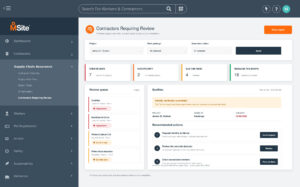
MSite's Extended Liability Right to Work solution has been designed around that wider problem.
Rather than treating the legislation as an instruction for principal contractors to repeat conventional Right to Work checks, MSite connects the worker to their employer, the relevant subcontractor hierarchy, Right to Work assurance and their real-world activity on site.
The employer remains responsible for completing or confirming the appropriate prescribed Right to Work process.
The principal contractor can obtain the assurance, evidence and audit trail needed across its supply chain, while subcontracting relationships can be understood and monitored.
Critically, MSite's workforce identity, biometric access control and attendance capabilities can connect Right to Work assurance with the person actually arriving at and working on the project.
This turns Right to Work from an isolated onboarding check into an auditable, continuing supply-chain compliance process.
Don't let misinformation create a false sense of security
The direct employer's statutory excuse and an upstream contractor's statutory excuse against extended liability are different protections with different requirements.
Additional Right to Work checks may form part of a wider compliance strategy. But businesses should be extremely cautious of suggestions that repeating a traditional Right to Work check on every subcontractor worker is, by itself, sufficient protection against extended liability.
The Home Office guidance sets out considerably broader requirements.
Construction businesses therefore need technology capable of managing the relationship between worker identity, employer, subcontracting chain, Right to Work assurance and ongoing site activity, rather than technology that simply performs another isolated identity check.
To our knowledge at the time of writing, MSite is currently the only construction workforce-management solution specifically designed to bring those elements together around the Home Office's extended-liability model.
With the new regime applying from 1 October 2026, understanding that distinction is no longer simply an issue of process design.
It is central to whether a business can demonstrate the statutory excuse it believes it has.
This article reflects the Home Office's Employer's Guide published in draft form on 11 September 2026 and the legislation and regulations available at the time of writing. Businesses should consider their individual contractual arrangements and obtain appropriate legal advice where necessary.