Principal contractors already hold huge amounts of information about their supply chains.
Procurement systems contain supplier information. Commercial teams hold contractual records. Project teams know which subcontractors they've engaged. Workforce systems can tell you who is attending site.
But can those systems collectively answer a more difficult question:
Who is actually delivering the work beyond Tier 1?
A Tier 1 subcontractor may appoint a Tier 2. That business may subcontract again or introduce a labour provider. Workers can therefore arrive on site employed or engaged by organisations several relationships removed from the principal contractor.
The information may exist somewhere within the business or its supply chain.
The challenge is whether it can be connected quickly enough to understand what is actually happening on a live project.
What is supply chain management software?
Supply chain management software is a broad term.
Depending on the industry, it can cover procurement, supplier management, materials, logistics, financial information, compliance and risk.
Construction adds another layer of complexity.
A principal contractor's supply chain isn't simply a database of approved suppliers. It's a network of contractors, subcontractors, labour providers, employers and workers coming together to deliver individual projects.
And those relationships can change throughout delivery.
That means the important question isn't necessarily whether a principal contractor has dedicated supply chain software.
It's whether its existing systems provide enough connected information to understand the delivery chain below Tier 1.
Having supplier data doesn't necessarily mean having supply chain visibility
Principal contractors generally have good visibility of the organisations they contract with directly.
The picture can become less clear further down the chain.
Imagine a Tier 1 subcontractor appoints a Tier 2. That business then introduces another specialist subcontractor or labour provider.
Could you quickly establish:
- Which organisations are involved?
- Who appointed whom?
- How many tiers the delivery chain contains?
- Which organisation employs or directly engages the workers attending site?
- Whether the organisations operating today are the same ones you expected at the start of the project?
You may already hold much of that information.
But if answering those questions requires several systems, spreadsheets, emails and phone calls, having the data isn't the same as having visibility.
What if construction technology could answer different questions?
For years, digital transformation has largely focused on turning manual processes into digital ones.
The next opportunity is different.
Instead of simply asking “What information have we collected?”, construction companies can start asking:
“What can this information tell us?”
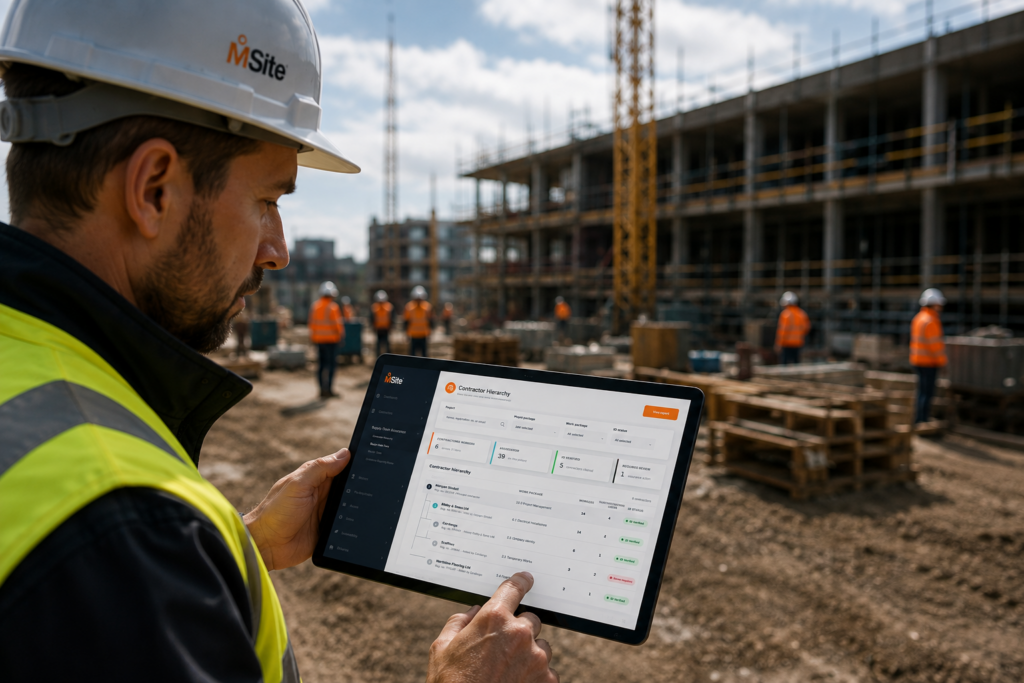
For supply chain management, that could mean understanding the relationships between the businesses and people actually delivering a project.
It could mean identifying when the supply chain you're seeing today differs from the one you expected.
It could mean focusing attention on exceptions rather than asking teams to manually investigate everything.
And it could mean being able to establish what happened at a particular point in time without reconstructing the answer from several disconnected records.
These are becoming commercial, operational and risk questions for all principal contractors.
The supply chain doesn't stand still
There's another limitation to traditional approaches to supply chain management.
Projects change. New subcontractors appear. Labour providers change. Workers move. Packages are subcontracted further. A business that wasn't involved at procurement stage can become important to delivery months later.
A supplier assessment therefore tells you something important about a business at a particular point in time.
It doesn't necessarily tell you how your project is being delivered today.
That's why the conversation around construction supply chain technology needs to move from records to relationships, and from point-in-time checks to ongoing assurance.
How much can you see today?
There's a simple way to assess whether you currently have enough visibility.
Pick a live project and ask:
- How many tiers does our supply chain contain?
- Which organisations are actually delivering work?
- Who brought each lower-tier organisation onto the project?
- Who employs or directly engages each worker?
- Which relationships require our attention?
- What has changed in the supply chain since the project started?
- Could we evidence all of this quickly if we were asked tomorrow?
The answers may be revealing.
Because the issue isn't necessarily that principal contractors don't have the data.
It's whether they can connect it.
What comes next for construction supply chain management?
The expectations placed on principal contractors are changing.
Commercial exposure, tax, workforce assurance and wider regulatory developments are putting greater emphasis on understanding what happens further down the contractual chain.
Technology has an important role to play in how the industry responds.
But simply digitising existing processes won't necessarily be enough.
The bigger opportunity is to connect the contractor, supply chain and workforce information construction businesses already generate, making it easier to understand how projects are actually being delivered and where attention may be required.
So what could that look like in practice?
That's a conversation we're about to take further.
See what's next in Manchester and London this September
What if you could understand your construction supply chain differently?
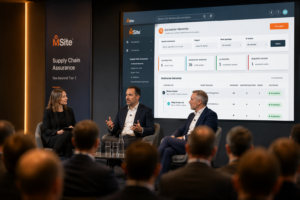
This September 2026, MSite is hosting two exclusive events in Manchester and London exploring the changing risks facing principal contractors, and what the next generation of supply chain management could look like.
You'll hear from MSite CEO Robert Brent alongside tax and legal experts, who will examine the commercial and regulatory changes affecting construction supply chains, what they mean for principal contractors and why understanding what happens beyond Tier 1 is becoming increasingly important.
We'll also be revealing what MSite has been working on.